
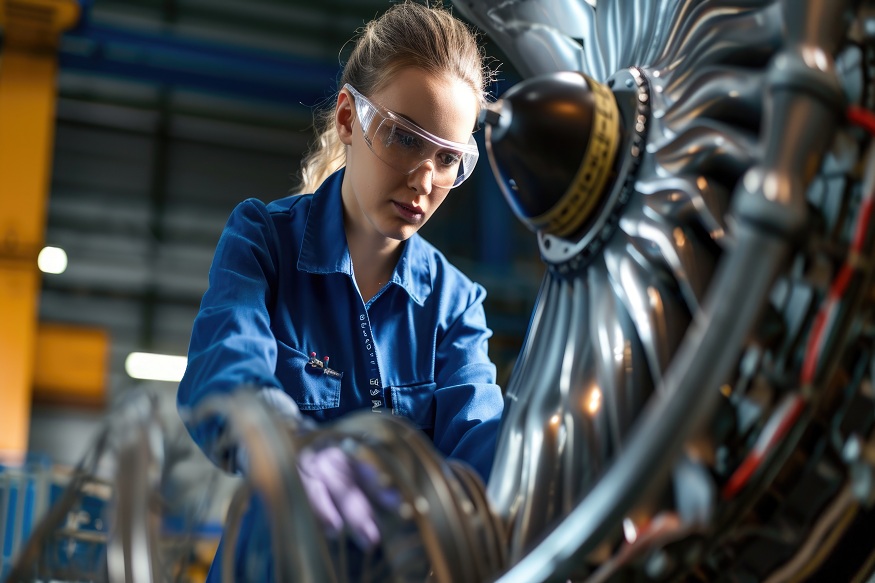
Step into an aircraft factory and you’ll witness something odd. A robot the size of a delivery truck drills holes with freakish precision; thousands of them, each one perfect. Thirty feet away, meanwhile, someone is feeling over a carbon fiber panel for tiny imperfections undetectable by sensors. Modern aircraft production mixes sci-fi and craft.
When Robots Rule
Some aircraft manufacturing jobs are mind-numbing. Take drilling. A typical passenger jet needs about three million holes. Every last one needs to be the right width, depth, and angle. Screw up hole number 2,847,293 and you’ve just created a crack waiting to happen.
Robots eat this stuff for breakfast. No coffee breaks. No sore wrists. No spacing out and drilling crooked because it’s 2 PM on a Thursday and lunch was four hours ago. Program the machine, hit start, go home. Come back tomorrow to perfect holes.
Paint shops have gone the same way. Those robot arms swinging around, spraying jets? They lay down paint as if they’re frosting the world’s most expensive cake. Same thickness everywhere. No runs on vertical surfaces because somebody got impatient. And robots definitely don’t complain about working in a fog of toxic fumes all day.
The Human Touch Still Matters
While consistent, robots lack intelligence. They follow instructions. Period. Can’t think, won’t adapt, definitely won’t tap you on the shoulder to say, “Hey, something seems weird here.” Composite work shows why people still matter. Laying up carbon fiber is like working with the world’s most expensive and temperamental fabric. Pull too hard, it bunches. Too gentle, you get wrinkles that’ll cause problems in five years when nobody remembers who laid that piece. Good technicians develop a feel for it. Their fingers know when something’s wrong before their brain catches up. No robot has that instinct.
Read More:The Surprising Places People Store Their Most Valuable Belongings
Then there’s cable routing. Miles of wiring need to thread through spaces that seem physically impossible. Around sharp corners, away from hot spots, through gaps barely wide enough for the bundle. Robots see obstacles. Humans see puzzles and actually enjoy solving them. A technician will figure out that if you rotate the bundle forty-five degrees and approach from below, everything fits perfectly. Try programming that creativity.
The Sweet Spot
Smart factories stopped picking teams years ago. They mix robots and people like a good DJ blends tracks. Working with advanced composites demonstrates this perfectly. Companies like Aerodine Composites show how human expertise and robotic precision create something neither could achieve alone. Laser cutters slice raw materials down to the millimeter. Computers track every piece like bloodhounds. But when it comes time to layer those materials just right? That’s when experienced hands take over.
Wing assembly tells the whole story. Robot arms position massive aluminum sections and nail the alignment within a hair’s width. Automated systems punch holes exactly where engineers wanted them. But people make the final connections. They’re the ones who notice if something flexes weirdly or sounds wrong when tapped. Experience beats sensors when things get subtle.
Conclusion
Aviation manufacturing won’t become some fully automated wonderland where robots build planes in dark factories. But it’s also not going backward to the days of guys with rivet guns and steel rulers building everything by hand. What’s actually developing is more interesting. Each year, robots grab the boring, repetitive jobs that wreck human bodies and minds. That frees up skilled workers to handle the weird stuff, the tricky connections, the problems nobody saw coming. The factory floor becomes a partnership, not a competition. Tomorrow’s aircraft will come from places where robots amplify what humans do best, and humans guide what robots do fast. Neither side wins. Both sides build better planes.
Read More:How Hard Money and Bridge Loans Can Turbocharge a Property Portfolio